
ERRORS and Advanced CORRECTION
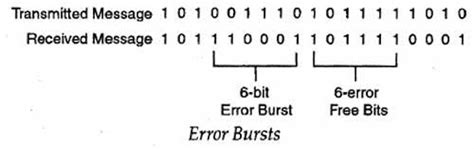
A Reed Solomon code is a correction modality whereby error correction is accomplished over a so called Galois Filed. A known technique of correcting burst errors in communication systems typically tries to resolve what is called a burst error. This is a symbol group that upon reception across a transmission channel results in a group of errors that are difficult to correct; many times the ‘alpha’ and the ‘omega’ symbols of a word or group thereof arrive at the transmitter corrupted which complicates the correcting process. Additionally, no group of related symbols in the data is correctly received making it highly unlikely or even impossible to correct the stream.
A typical technique for dealing with this situation is to interleave the data word if it has a typical length into a helical recoverable information stream. Here data packets are encoded in offset portions from packet to packet forming the helical pattern. In the event there is an error in the word, then the interleaving technique can effectively work provided that n-1 words are interleaved. Thus, if there are errors in a word the words that are adjacent (of the other n-1 words) are marked and errors can be auto indicated at these positions relative to the burst error so that they can correct the aforementioned.
Advanced Correction System
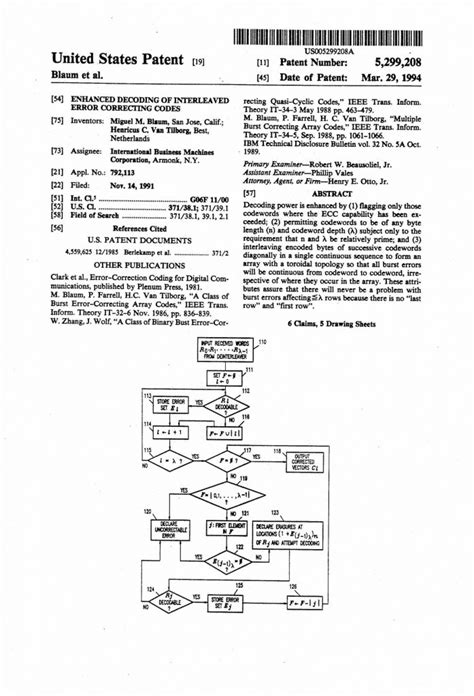
In this enhanced system an encoder takes in data and passes it to an interleaving device. The interleaver arranges the data stream such that the final matrix creates a system of ensuring that all burst errors are continuous from packet to packet no matter their position in the matrix. Because of this the burst of errors is spread across the data packets and matrix as a whole. This technique ensures correction and recovery of the information stream as the data stream does not become corrupted at a single point thereby limiting its correction. Rather the burst is spread across numerous packets.
In order to accomplish the correction of this data the symbol of each packet in the sequence is interleaved into a matrix of diagonal information. A packet (or group) is arranged such that a first portion thereof placed diagonally across the information matrix is followed by the next packet (or group) and so forth. Thus, any burst errors occurring as it traverses across the communication channel affect various codewords instead of blasting a single word or immediately sequential block of data as this would make the information unrecoverable.